Wednesday, April 18, 2012

Artists in Paris


An American in Europe, Henry Clay Crockett, London Printing and Publishing Company, 1850


"We travel, or rather dreamily wander round and round."--The American in Europe
"Montmartre, a hundred years ago, was much more distant from Paris than it is now  It was the heart of a rich and beautiful country, but the encroachments of the great growing monster--the city."


We looked around at the Universite de Paris, where many Americans are known to study during their time abroad.  We are not taking time to study on this journey, instead learning as we go through the world’s classroom.  But if I were to take time somewhere around the world, I think it would be here.  There are artists and writers and chemists and philosophers: so many famous pioneers of the world of learning.  The universite has a chemistry class in which Marie Curie is a guest lecturer.  The philosophy department celebrates the groundbreaking work of Descartes.  But for me, the true draw is the writers, both French and foreign, who call Paris their home.
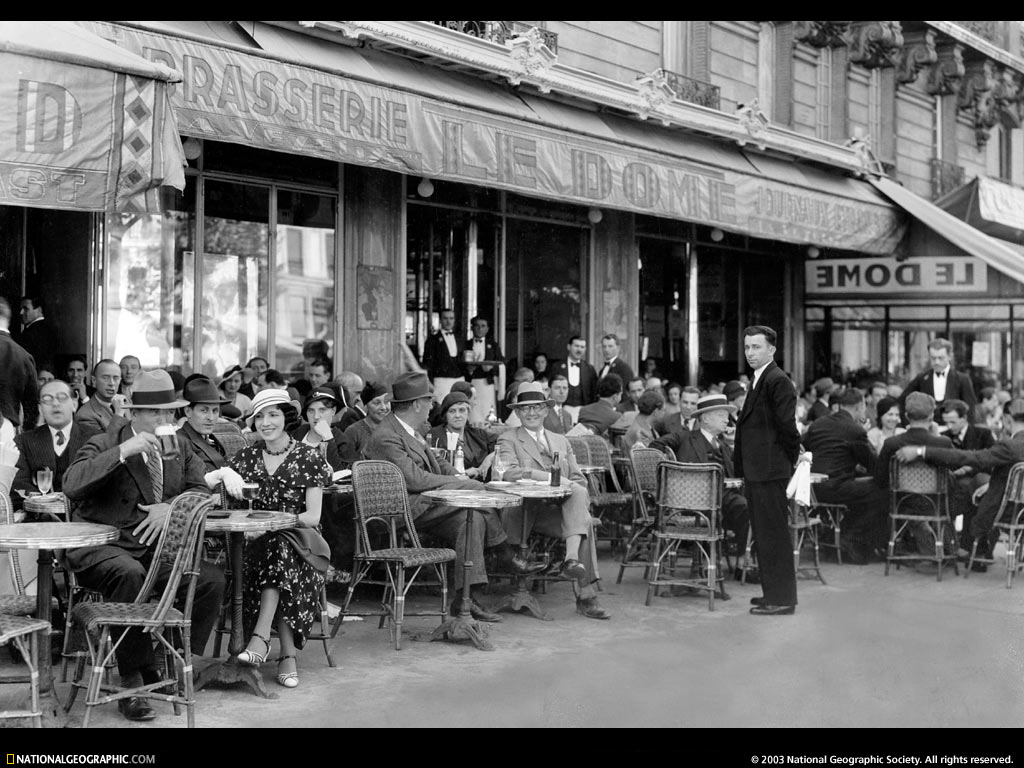
Sitting on the left banks of the Seine, the presence of the Lost Generation of writers is everywhere.  Hemingway and Fitzgerald live here now, producing some of their best work while away from their American home. Right here in Montmartre, the Left Bank’s artistic center, artists and intellectuals flock together and celebrate creation. The inspiration is everywhere, from the old houses and apartments of Picasso, Dali, Rousseau, Matisse, and more.  The cafes are filled with struggling writers drowning in social inspiration.  We lunched in one of the cafes where Hemingway is known to be spotted, and although there were many dark, brooding men alone at tables with multiple glasses of whiskey, we did not catch a glimpse of him.  We felt at home, surrounded by all these Americans in Paris, but it also felt quite unfair, that we were here taking over and transforming the beautiful French culture.

Intellectually stimulated for more than our fair share, we spent the afternoon and into the evening shopping Paris’s smaller flower and bird markets. They are tucked away from the main Rues, and buy and sell everything imaginable: fresh flowers, plants, pets, livestock, meat, fruit, cheeses, warm bread, wine, and every other small luxury that makes Paris so enjoyable. The Parisian matrons were yelling in French, haggling on dinner supplies for their family while the boys played with sticks in the dirt and the girls followed closely behind their mothers, learning the ways of the market.  We were surely out of place, as not a single person spoke English, though many stall keepers tried to attract us with short bursts of English phrases: “Pretty things! I sell you!” they called uncomfortably.  We purchased more bread and cheese than we could eat for a week, some precious trinkets and fabric to bring home, and a bouquet of fresh flowers for the matron at our boarding house in the 7th Arrondisement.
Jardin Mabile, Paris, where we explored after hours in the City of Lights.

 The hustle and bustle of the city life was surely still present here, but tucked away from the city we were able to enjoy ourselves more, and I really pictured myself coming back and making a life here among the artists and bohemians.

Wednesday, April 11, 2012

The Emerald Isle

Text: “The Boy Travellers in: Great Britain and Ireland” by Thomas Knox, Harper and Brothers, 1891.

On American Travelers, page 2: “They are in a hurry to get to London, and determine that they will see Ireland on their way home…but they longer so long on the continent and in England that they have no time to stop on the way home; and that’s the way Ireland is neglected by the Americans.”
"Why is Ireland the richest country in the world? Because its capital is Dublin every day." :)

 We sailed from New York directly to the port of Queenstown, in the Cove of Cork, in Ireland.  The journey was less than luxurious, and marked by heavy rainstorms, but as The Boy Travellers pointed out, “the frequent and copious rains gave the hills of Ireland the beautiful green that greeted [our] eyes.” (Pg 4) We were more eager to reach the Emerald Isle and continue our sightseeing than to waste time being bothered by the rain, so we spent the steamship journey talking to passengers about their own voyages and gaining a wealth of knowledge and invitations to dinner by wealthy English businessmen.  We promised to call on a few gentlemen when we reached London, but wished to explore those green hills and cliffs of Ireland first.

Blarney Castle, site of the famous Blarney Stone near Cork, Ireland
 After landing in Queenstown, the typical route to Dublin crosses right through the city of Cork and the village of Blarney, which is a huge tourist destination thanks to the poetry of Father Prout, who wrote: “There’s a stone there that whoe’er kisses, sure he ne’er misses/To become iloquint.”  Nowadays, tourists from miles around come to kiss the Blarney stone in hopes that they will win the gift of words.  We were no exception to the superstition, and leaned in to the fragment of the Blarney stone—“not the real one, which is in the wall of the building many feet from the ground, and can only be reached by the lips of a person who is suspended by his heels from the top of the castle four or five feet above.” (Pg 13) and planted a humorous kiss on the cool granite.  For the truly adventurous, it is possible to climb to the top of the castle and reach the true stone, but it does trigger a fear of heights and is not for everybody. I have yet to notice any impact on my ways of speech, but perhaps the skill takes a few days to acquire. 


Lakes of Killarney, some of the beautiful scenery of Ireland.
From pg 21 of The Boy Travellers.
The Irish countryside, which we traveled thoroughly, is full of ancient and crumbling castles, abbeys, monasteries, and the like.  In addition to the rich human history, it is also a beautiful country of waterfalls, lakes, and the famous mountainous cliffs.  I was in awe at the richness of the shades of greens, blues, and browns that cover this country.  Many of the lakes and falls reminded me of our visit to the Yosemite valley, though the air here has a much more distinctive chill, and the sense of rain is almost constant, as if a light mist continually sprays without any particular accumulation o water.  We spent our time in the Irish countryside in a perpetual state of dampness, but it was worth it for the lush vegetation in which we were surrounded.  It is hard to believe that only a few decades ago this entire landscape was devastated by drought and famine.  The environment seems very healthy for potatoes and other crops. 

Man from Limerick
county, from
The Boy Travellers
The Irish people are very proud of their ancestry and roots.  Even the poorest, smallest children can stand up proudly and recite the occupation of their grandfathers.  Tempers run high between families, and the local pubs are always a raucous celebration or argument of familial pride.  We frequented these pubs in the crowded, dirty, but proud neighborhoods of poor Dublin.  To see the true life of the people is the most important goal of this journey. 

My family hails from Limerick, which we saw on our country drives, and when my name was mentioned at the pub there the patrons burst into roars of acceptance and treated us like family for the rest of our stay. I could have stayed there with my new family for days, but we’ve got a whole world to see.  The green hills, clear lakes, and proud people of Ireland will not be forgotten.

Sunday, April 8, 2012

An Evening at the Theatre


Texts:
 Lights and Shadows of New York Life; or, the Sight and Sensations of The Great City. By James D. McCabe, National Publishing Company, 1873.

Theater Program: “The New Yorkers” at Broadway Theater, New York Theater Program Corp Publishers, opening Jan. 5, 1931.

From Sight and Sensation of the Great City: “The theatres: There are usually from 50,000 to 100,000 strangers in the city, and the majority of these find the evenings dull without some amusement to enliven them.” Pg 470 
“In no other city are such establishments as elegant and commodious, and nowhere else in America are the companies as proficient in their art, or the play so admirable put on the stage.” Pg 471


With our few days’ overlap in the “Greatest city on earth,” we decided we must explore everything this city is so famous for: the central Park, the statue of Liberty given by the French, the libraries and museums and cultural centers.  New York is such a fashionable, high society place, though poverty, crime, and danger lurk among many dark corners.  According to James McCabe, author of “Sights and Sensations,” “It is not safe for a stranger to undertake to explore these places for himself…no respectable man is a match for the villains and sharpers of New York.” 

In this era of Prohibition, an underground culture of speakeasies, dance halls, and street workers borders the edge of some of the most respectable destinations.  In order to protect ourselves from the dangers laid out by such a big city, we mostly tour during the day, where one can glimpse the underground culture but not be engrossed in it.  We decided, though, that no trip to New York is complete without a trip to the legendary theaters.  Musicals, opera, drama, Shakespeare, vaudeville, and more grace the dozens of stages of New York each night.  Many stage stars have their own following by members of the elite here, who attend the lavish opening night events of each of their new shows.  Film stars beloved across the nation are also beginning to cross back over into stage work, bringing a celebrity quality to the most classic of productions. 

"The New Yorkers" theatre program, January 1931.
We decided to splurge on tickets to a production of “The New Yorkers” at B.S. Moss’s Broadway theatre, in order to have the most classically new York evening.  The play was described as a sociological musical satire and pokes fun at New York stereotypes, including the elite, conmen, thieves and prostitutes. It was a whirlwind romantic tale about a socialite named Alice and her relationship with a bootlegger name Al.  It included such musical numbers as “Say it with Gin,” “”The Great Indoors,” “Take Me Back to Manhattan,” and other tales that made it a pleasure for New Yorkers and tourists alike, as it gave a humorous picture of the lives of the residents of such a city. 

The theater program, which I saved as a memento of the experience, includes articles on up-and-coming New Yorkers, the latest fashion trends, and some warnings about the fall of the economy.  It is clearly directed at the socialites who frequent the theater.  Advertisers flock to the theater program in order to target such an elite audience, but it was enjoyable for us as visitors as well. 

After the show, we visited a dance hall popular with the young people of the city.  It was an adventure in nightlife that we had previously shied away from, due to James McCabe’s warnings, but we learned that with a little common sense there is no reason not to enjoy New York’s many offerings at all hours of the day.  This risk-taking also served us well for the coming adventures in Europe and the rest of the world!  Tomorrow we leave new York and America for good, setting off across the Atlantic for a tour of European Greats, ancient ruins and indigenous cultures of Northern Africa, an East Indies passage through India, and a recreational jaunt around the south Pacific.  The world is literally ours to explore.

Wednesday, March 28, 2012

Cross Country Freedom


U.S. Interstate Highways, October 1st, 1937
National System of Interstate and Defense.

“I am taking it for granted that you want to go camping, that you know the joys of the out-of-doors, of fishing, hiking, motoring, meeting new people, seeing the deserts, mountains, lakes, forests, and the thrill of looking to see what is around the next bend of the road”--From Leisure League Little Book Number 22: Motor Camping by Porter Varney, 1935

     
In order to make the most of our time America before sailing across the Atlantic in one moth’s time, we have decided to drive cross-country in our own car.  This way, we have the flexibility to decide when and where to go and which attractions to see, and the opportunity to save money by sleeping under the stars along the way.  It is legal to camp on any National Forest land in America, and designated camping spots are cropping up in abundance.  Since I have never done a trip with this much planning and independence, we turned to the Motor Camping guidebook for advice. 

  Since we were already in the Southern United States, we decided to keep the most southerly route, through California, Arizona, New Mexico, Texas, then north through Missouri and Illinois and on east to New York.  The most convenient highway route is Route 66, also known as Main Street America, filled with the iconic American symbols of growth, exploration, and travel.  We like to think of ourselves as reverse Lewis and Clarks, exploring territory previously unchartered to us, to say the least.

            We packed the car using the advice of the guidebook, bringing only what we need for the two-week drive.  They suggested, and I highly agree, that having a comfortable place to sleep is the most important part of a camping excursion:
“Even though you have a sunny disposition it is apt to be a little clouded after spending the night with a stone or root performing chiropractic treatment on your spine, or your duffel soaked by a heavy rain.” (Page 27)
Motor Camping with a tent, as suggested by the Leisure League.
 This ominous message scared us into equipping the backseat of the car into an easy sleeping area:  With just a few minor tweaks, the backseat now folds completely down into the trunk to form a comfortable two-person sleeping bench.  Two sleeping bags and two extra blankets provide adequate warmth for any variety of weather, though our weather will be mostly hot, the desert is known to get chilled at night.  This plan removes the need to carry a canvas tent, which is bulky, heavy, not easily dried in case of a rainstorm, and which we will not need upon reaching New York. The rest of our clothing, food, and gear fits easily under the seats, as we set off on this journey with the bare necessities in order to make traveling from point A to Point B as simple as possible. 

We found tackling the Great Southwest in this manner to be very convenient.  We brought food along as we wished, or stopped in towns during mealtimes.  We visited the Grand Canyon at sunset, in awe at the striking red, purple, and orange of the sky sinking into the red dirt of the canyon.  Arizona and New Mexico are rich with the culture of Native Americans, which we saw throughout our drive.  The people are simple and friendly, and eager to share their culture.  We watched Indian women make Chimayo blankets, visited an old Mexican village and trading post, and saw the Indian pueblos, all while speeding along across the country.  We were primarily interested in reaching the east coast, so drove an average of eight hours a day through the dry and dusty landscape, awaking early before sunrise and often pulling up to a campsite after dark, as we took many breaks to visit the land.

As we pulled north out of Texas, the scene began to look more familiar, and we stopped to fish in the Midwest river valleys and made great time over the expansive plains.  Farmhands often offered us a fresh lunch on the farms we passed, and we eventually arrived in New York in excellent spirits, eager for a few days rest before the international adventure began. Driving the car allowed us to create our own adventure and visit the things we found most interesting, but the best part was the freedom to pull over on the side of the road to sleep under the stars wherever we wished.


Thursday, March 8, 2012

Exploring the Yosemite Valley

Stop #2 on my tour.

Texts: The Yosemite Guide-book by J.D. Whitney, State Geologist to California, 1870.


From The Yosemite Guidebook:
"The Yosemite Valley is a unique and wonderful locality; it is an exceptional creation, and as such has been exceptionally provided for jointly by the Nation and the state--it has been made a national public park...that of holding the Yosemite Valley as a place of public use, resort, and recreation, inalienable for all time!"

"What gives its peculiar character to the Coast Range scenery is, the delicate and beautiful carving of their masses by the aqueous erosion of the soft material of which they are composed...the general absence of forest and shrubby vegetation.  The bareness of the slopes gives full play to the effects of light and shade caused by the varying and intricate contour of the surface."

Horeseback riding to Bridalveil Falls

"Bridalveil falls is formed by a creek of the same name, is precipitated over the cliff into the Yosemite [river] in one leap of 630 feet perpendicular. The effect is finest when the supply of water is not too heavy, since then the swaying from side to side, and the waving under the varying pressure of the wind as it strikes the long column of water, is more marked." --The Yosemite Guidebook

We left the visitor's center on horseback at an early hour, and watched the sunrise as we rode in a group of ten down the wagon trail to the base of Bridalveil falls. The trail is called Mariposa, Spanish for butterfly, and hosts a variety of wildlife of various kinds.  We saw small rodents, insects, calm deer in the morning light who ran off at the sound of our horse's hooves.  I imagine we may have seen more had we been travelling by foot--the guide mentioned black bear, coyotes and mountain lions, but I for one am glad we had the protection of the horses and didn't glimpse these creatures out in the wild alone.  I'm thrilled they are alive and well in the park though.

More stunning than the animal life, though, is the natural landscape for which the park is famous.  The trail descends steeply into the heart of the yosemite valley and the horses stepped sure-footedly, even if we were  a little unsteady on their backs.  I had to trust the horse and guide to watch the trail because my attention was immediately drawn up, up, up to those majestic cliff faces.  The enormity of it all, shooting straight up from the ground on both sides of us, was enough to shrink me down to an ant on the trail.  We saw El Capitan, directly facing Bridalveil Falls, the famous Half Dome, Sentinel Rock, and other hugely impressive rock formations.  each one us huge and spectacular in its own way. We hope to return again to climb to the top of El Capitan, providing us with an entirely new perspective.
Woodcut drawing of El Capitan and Bridalveil Falls,
as seen from afar as we approached on horseback.
Yosemite Guidebook.
Bridalveil Falls was spectacular in the cool morning.  We let the horses stop and drink from Bridalveil Creek as we walked up to the very base of the falls, enjoying the spraying mist and swaying curtain of water above our heads.  It looks surreal, something built by special effects and human hands rather than a natural phenomenon.  It is sights such as these that make me appreciate the preservation of national parks such as Yosemite.

We spent the rest of the day admiring the sharp granite Spires, Cathedral Rock, and countless other formations as we sauntered back around the loop of the trail to the visitor's center.  The day was hot already and we were tired despite enjoying the convenience of horseback all day!  We read from the guidebook about the volcanic history of the granite formations and the unique desert-y landscape of the Valley.  Our beautiful visit was marked by plenty of sun and exercise and awe at the natural beauty of this national gem. We are now at the leisure of driving across the country in our family car, stopping at any which landmark along the way and camping as we go.  This is our next adventure on our world tour!

Thursday, February 23, 2012

Picturesque Alaska

Texts: Picturesque Alaska: A Journal of a Tour Among the Mountains, Seas, and Islands of the Northwest, from San Francisco to Sitka by Abby Johnson Woodman, c. 1889.

All About Alaska  Travel Pamphlet produced by the Pacific Steamship Company, c.1889

Travel Pamphlet Cover, 1889
From All About Alaska:
"What there is in Alaska to admire:...you will see, admire, and pass through channels, straight as an arrow and of unfathomable depths, banked on either side by perpendicular and gigantic mountains, whose untrod summits are clothes in clouds and ice. But what will interest you most will be the Glaciers--glittering in the distance until you have an opporunity to climb on one.
"You will be amused at their totem poles--which are made by cutting down a good, straight tree, dressing it down to the desired size, then carving it in a very rude way, with figures of birds, Indian warriors, and other fantastic shapes...they are raised and planted on end before the owner's hut."
"Having arrived home: You will find your eyes clear and sparkling, your appetite keen, your step more elastic, your general health immensely improved.  You will have lots of stories to tell of your experiences, which will make you the lion of your social gathering and the envy of those who stayed home." 
The Muir Glacier, in Glacier Bay, woodcut drawing from Picturesque Alaska
The steamship enters Glacier Bay, and the entire world comes ablaze in light.  The late afternoon sun, still high in the sky in early summer, throws its beams on every surface, and they throw them right back.  The glittering deep blue of the sea, the mottled sky and clouds, and the pure, icy, crystal clear blue of dozens of glaciers, surrounding the bay on three sides, reaching the water and meeting the sky.  The entire world was awash in the sparkling blue light, and the entire passenger population came up on deck to bask in the beauty of it.  We docked at the port of Juneau, a small city on southeast Alaska.  Home to native people, Russian settlers, as well as Americans in the fishing and mining industry, the town is growing, and quite easily accommodates our passenger ship with seafood restaurants near the harbor, excursions into the forested mountains directly encasing the town, and glacier climbing trips.

Totem poles, woodcut drawing
from Picturesque Alaska
We sign up to trek on a glacier.  The leaders bring strong mules, connected by heavy rope. We slide primitive spikes to our shoes--the thing could very well be an early torture device, but it effectively gains traction on the uneven, icy surface of the glacier.  Climbing in a glacier becomes much easier than it appeared from that glittering world of blue that we approached from the Bay.  The ice slides directly down to a small visitor's shack--it must be temporary because the glacier moves anywhere from several inches to a few feet per year, and may overtake the visitor's center in any given winter, when climbing is closed.  The seven participants--four from the steamship, myself, and two cousins visiting a Russian aunt in the town--assemble in a line between the guides and mules and we begin our slow trek across the ice.  The ice is cut in grooves and it takes a lot of caution, but there is no fear of sliding right off the surface, as the spikes on our feet protect from danger.  There is plenty of rock and debris not visible from the ship that adds to our traction.  The visitor's center has taken great caution to rope off a short, safe section to climb on--if we were left to our own devices we'd surely find the nearest crevice to fall into.  For about one hour we stumble back and forth across the surface, enjoying the rising chill from the glacier's surface and the beating sun on our heads.  

photo courtesy of ricksteveseurope.com
The guides encourage us to purchase posters, etchings, jars of authentic "glacial silt," which is really just glorified dirt" in the visitor's shack.  I politely decline, preferring instead my own mental image of that glittery world, the cool smoothness of the trek, the up-close details of the glacier's surface carved and etched into the ice.  I do wish to purchase the ice spike I wear on my feet, but deny their practicality and move on, instead drawing a picture here of my best attempt.  We returned to town chilled and hungry, but with a new appreciation for those enormous frozen rivers that cover this landscape.


Around the World

Trinity College Raether Library holds in its basement level of seven miles of shelving that constitute the rare books collection of the Watkinson Library.  These works range from the 11th century to the present, and include not only manuscript but pamphlets, maps, art prints, college archives, and more.

Through a Fellowship Program funded by the Watkinson, I am embarking on a creative journey using the various works held there.  My project is founded in my love of travel and I quite literally plan on journeying "around the world."  My project has two parts:  this blog will house the written component of my journeys.  I'm writing a somewhat fictionalized/imagined travelogue, based on readings and quotes from works in the library.  These works include travel pamhplets and advertisements from the late 19th century, captains' logs from the 1500s, travel diaries from the 1920s, and more.  My journey will not be set at any one point in time, but I instead grant myself the freedom to land myself in any era that catches my fancy.

In addition to the online recording of my travels, I will also create a visual representation of the journey.  My map will include a variety of materials and photos from each destination, and will have a direct link to the online travelogue.  This map will be on display in the Watkinson upon completion.

So, I'm off on my journey!  Happy travels and make sure to check back here as I go.